
Sequence of Returns Risk:
The Retirement Danger Few People Warn You About

You've worked for decades. You've saved, sacrificed, and done things the right way. Retirement is finally in sight. I know I cant wait for that day.
Ive noticed that most people in that season ask one question: Do I have enough? It's a good question, but it leaves out another one that can matter just as much: What happens if the market drops right when I start taking money out?
That second question has a name, and most people have never heard it. It's called sequence of returns risk. I want to explain it in plain English, because understanding it before you retire can change how you plan. Unfortunately, this education is not prioritized, and that was just another confirmation that the idea for Kingdom Wealth was Holy Spirit led.
What is sequence of returns risk?
Sequence of returns risk is the risk that market losses happen at the wrong time, usually in the first few years after you retire and start withdrawing money.
While you're working and saving, the order of good and bad years doesn't matter much. You're adding money, not taking it out, and you have time to recover. Once you retire, that changes. When you're withdrawing from savings during a down market, you're selling while prices are low. That money is gone, and it can't recover when the market comes back.
In other words, two people can earn the exact same average return over their retirement and still end up in very different places, simply because the good and bad years came in a different order.
A tale of two retirees
Meet David and Maria. This is a hypothetical example to show how the math works.
Both retire with $500,000 in savings.
Both take out $30,000 at the start of each year to live on.
Over 10 years, both experience the exact same set of yearly returns, averaging 4% a year.
The only difference is the order. David retires right into two down years (-15% and then -10%), followed by better years. Maria gets the better years first, and her two down years come at the end.

Same savings, same withdrawals, same average return. Yet after 10 years, Maria has about $126,000 more than David.
David didn't do anything wrong. He just retired at the wrong moment(again, not his fault), and the early losses shrank his savings while he was still withdrawing. Even when the good years came, they were working with a much smaller amount.
Hypothetical example for illustration only. It does not represent any specific product or investment, does not include taxes or fees, and is not a prediction of future results.
Why the first five to ten years matter most
The years just before and just after retirement are sometimes called the "retirement red zone." Your savings are usually at their largest, and you're about to start depending on them for income. A big loss here can affect every year that follows.
No one can predict when the market will rise or fall. That isn't the goal. The goal is to have a plan that doesn't fall apart if the timing turns out to be bad.
What Joseph teaches us about preparing
In Genesis 41, God gave Joseph insight into seven years of plenty followed by seven years of famine. Joseph didn't panic, and he didn't ignore it. He made a plan:
"This food should be held in reserve for the country, to be used during the seven years of famine that will come upon Egypt, so that the country may not be ruined by the famine." (Genesis 41:36, NIV)
Joseph didn't know exactly how each year would go. He prepared during the good years so that the hard years wouldn't ruin what had been built.
Scripture puts it simply:
"The prudent sees danger and hides himself, but the simple go on and suffer for it." (Proverbs 27:12, ESV)
Preparing for a market downturn isn't fear. It's faithful stewardship of what God has entrusted to you, so it can keep serving your family, your generosity, and your future.
How people prepare for it
There's no single answer that fits everyone, and the right approach depends on your whole picture. Here are some of the ways people think it through before retirement.
1. Know your income number. Start with how much you'll need each month to live. Without that number, it's hard to know how much of your income depends on the market.
2. Separate near-term income from long-term savings. Some retirees set aside money for their first few years of income so they aren't forced to withdraw from market-based savings during a downturn.
3. Build a foundation of dependable income. Social Security and pensions are income sources that don't depend on how the market did this year. Some people also look at insurance-based options, such as annuities with lifetime income features, to cover more of their essential expenses. Annuities aren't right for everyone. They have their own terms, fees, and surrender periods, so it's important to understand how they work before deciding.
4. Stay flexible when you can. Being able to trim spending a little in a down year can take pressure off your savings.
5. Don't forget taxes, health, and family. How your income is taxed, how you'd pay for extended care, and whether your beneficiaries are up to date all affect how long your money lasts. A tax professional can help with the tax side.
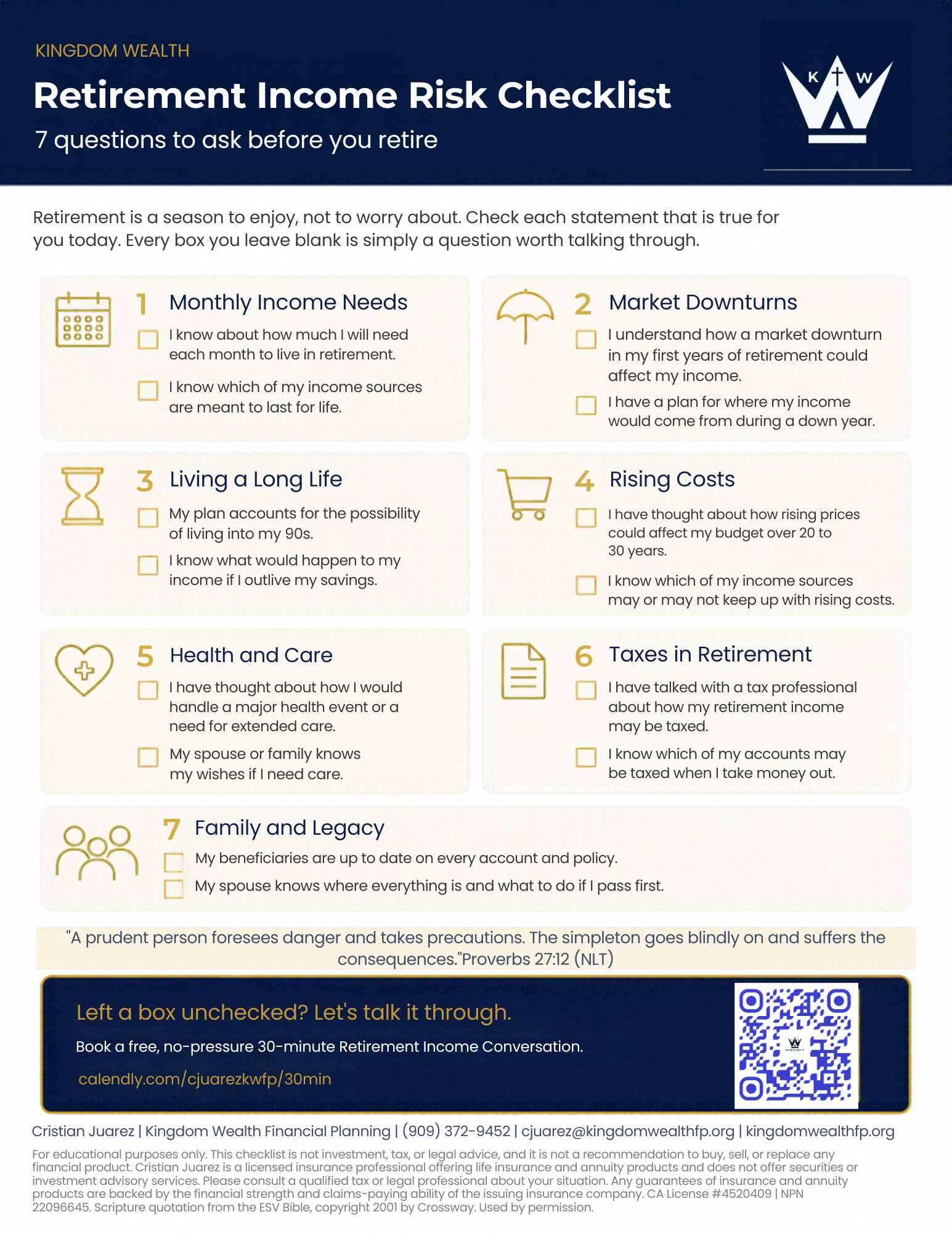
Take the free Retirement Income Risk Checklist
Want to see where you stand? Our free one-page Retirement Income Risk Checklist walks you through seven questions every pre-retiree should be able to answer, from market downturns to living a long life. It takes about two minutes, and every box you leave blank is simply a question worth talking through. There's no anxiety, pressure, or shame when you are walking with Christ.
Frequently asked questions
What is sequence of returns risk in simple terms?
It's the risk that market losses happen early in retirement, while you're withdrawing money. Losses at that point can shrink your savings faster and make it harder to recover, even if later years are strong.
When is sequence of returns risk the highest?
It's usually highest in the five years before and the first five to ten years after retirement. That's when your savings tend to be largest and you're starting to rely on them for income.
Does this only affect people with large savings?
No. It affects anyone who will draw income from savings that go up and down with the market. A smaller nest egg can feel the impact even more, because there's less room for recovery.
Can sequence of returns risk be avoided completely?
No one can control when the market rises or falls. What you can control is how your income plan is built and how much of it depends on market timing.
Plan before the timing is out of your hands
You can't choose the year the market drops, but you can choose to prepare before you retire. Joseph prepared in the years of plenty, and you can do the same.
If you're within ten years of retirement, or already retired, let's talk it through together. Book a free, no-pressure Retirement Income Conversation. We'll look at where your income will come from, how much depends on the market, and the questions on your checklist that are still blank.
Still building your foundation? Start with What Does the Bible Say About Debt? A 6-Step Plan to Get Free.
About the author
Cristian Juarez is the owner of Kingdom Wealth Financial Planning, helping Christian families protect, grow, and leave a legacy with what God has entrusted to them. Reach Cristian at (909) 372-9452 or cjuarez@kingdomwealthfp.org.
For educational purposes only. This article is not investment, tax, or legal advice and is not a recommendation to buy, sell, or replace any financial product. The example shown is hypothetical, does not represent any specific product or investment, and does not include taxes or fees. Past performance does not guarantee future results. Cristian Juarez is a licensed insurance professional offering life insurance and annuity products and does not offer securities or investment advisory services. Annuities are long-term insurance products that may include fees, charges, and surrender periods. Any guarantees are backed by the financial strength and claims-paying ability of the issuing insurance company. CA License #4520409 | NPN 22096645. Scripture quotations marked NIV are from the Holy Bible, New International Version®, copyright © 1973, 1978, 1984, 2011 by Biblica, Inc.® Used by permission. Scripture marked ESV is from the ESV® Bible, © 2001 by Crossway. Used by permission.